2025-11-07 20:28 Tags:
Definition
Feature scaling is the process of transforming numerical variables so that they share a similar range or distribution.
This prevents variables with large numeric ranges from dominating model training.
Why It Matters
Machine learning algorithms rely on distance or gradient-based optimization.
If features have very different scales (e.g., age = 0–100 vs. income = 0–100000),
the algorithm may:
-
Take uneven optimization steps
-
Converge slowly or not at all
-
Give undue weight to large-magnitude features
Feature scaling makes optimization faster and more stable. If you don’t know whether you need to do the feature scaling, then just do it, there is no ‘real’ drawback.
Common Methods
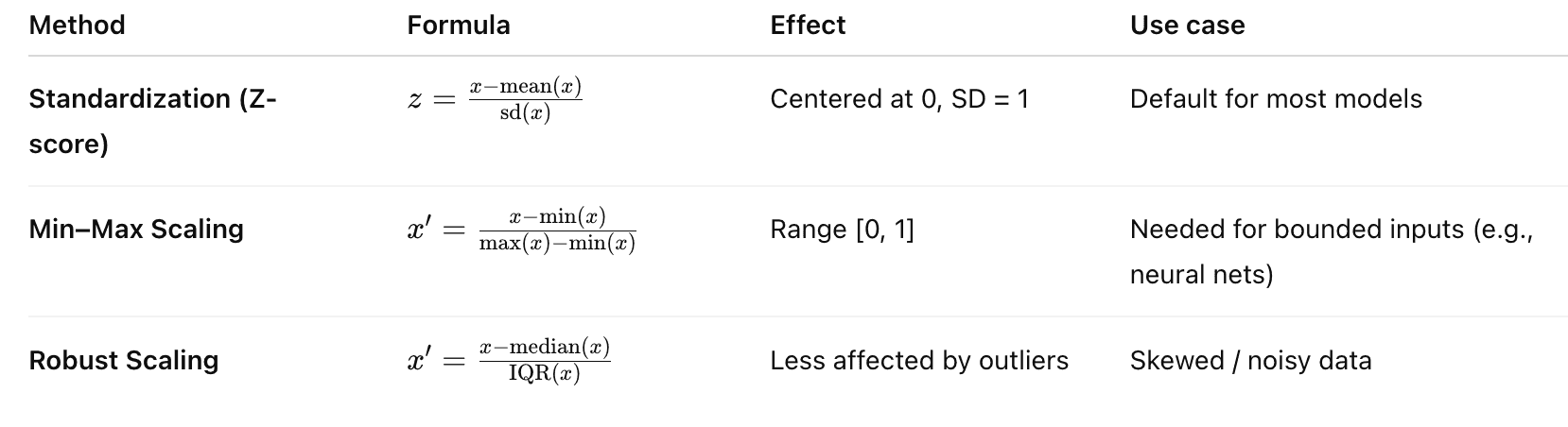 most two ways:
- standardization Z score which is Normal Distribution
- normalization range 0-1
Algorithms That Need Scaling
| Needs Scaling | Doesn’t Need Scaling ❌ |
|---|---|
| Gradient-based models (Linear/Logistic Regression, Neural Nets) | Tree-based models (Random Forest, XGBoost) |
| KNN, K-Means, PCA, SVM | Naive Bayes |
1️⃣ The Problem: Features on Different Scales
Imagine a dataset like this:
| Feature | Example values |
|---|---|
| Age | 20 – 90 |
| Blood pressure | 90 – 180 |
| Income | 20,000 – 200,000 |
| Distance to hospital | 0.5 – 30 |
The ranges are completely different.
Example input row:
Age = 40
BloodPressure = 120
Income = 80000
Distance = 10
Now imagine a regression model:
But:
x1 ≈ 50
x2 ≈ 120
x3 ≈ 80000
The income feature dominates purely because its numeric magnitude is huge.
Not because it is more important.
2️⃣ What Feature Scaling Does
Feature scaling rescales variables so they have similar ranges.
Instead of:
Age = 40
Income = 80000
We convert them to something like:
Age_scaled = 0.2
Income_scaled = 0.3
Now the model treats features fairly.
3️⃣ Two Main Types of Scaling
① Standardization (most common)
Formula:
Where
μ = mean
σ = standard deviation
This makes the feature:
mean = 0
std = 1
Example:
| Original | Scaled |
|---|---|
| 100 | 0 |
| 120 | 1 |
| 80 | -1 |
This is called z-score normalization.
Python example
from sklearn.preprocessing import StandardScaler

scaler = StandardScaler()

X_scaled = scaler.fit_transform(X)
② Min-Max Scaling
Formula:
This converts values to:
0 → minimum
1 → maximum
Example:
| Original | Scaled |
|---|---|
| 10 | 0 |
| 20 | 0.5 |
| 30 | 1 |
Python:
from sklearn.preprocessing import MinMaxScaler

scaler = MinMaxScaler()
X_scaled = scaler.fit_transform(X)
4️⃣ Which scaling is better?
Most ML models prefer:
👉 Standardization
because many algorithms assume:
mean = 0
variance = 1
Examples:
-
logistic regression
-
linear regression
-
ridge
-
lasso
-
neural networks
-
SVM
-
PCA
5️⃣ When scaling is NOT necessary
Some models do not care about feature scale.
Tree models only care about splits.
Example:
age > 50
Whether age is 50 or 0.5 after scaling doesn’t matter.
Models that DON’T require scaling:
-
Decision Trees
-
Random Forest
-
XGBoost
-
LightGBM
6️⃣ Why scaling is critical for Regularization
Remember LASSO / Ridge penalty:
If features have different scales:
Income: 0–100000
Age: 20–80
The coefficients become incomparable.
Example:
β_income = 0.0001
β_age = 2
Age looks more important but actually:
0.0001 × 80000 = 8
Income effect is bigger.
Regularization breaks without scaling.
So the correct pipeline is:
Standardize
↓
LASSO / Ridge
7️⃣ Another reason: gradient descent stability
Many algorithms learn using gradient descent.
If features have very different scales:
The optimization landscape looks like this:
very narrow valley
Gradient descent becomes:
slow
unstable
zig-zagging
Scaling makes the loss surface rounder, so training is faster.
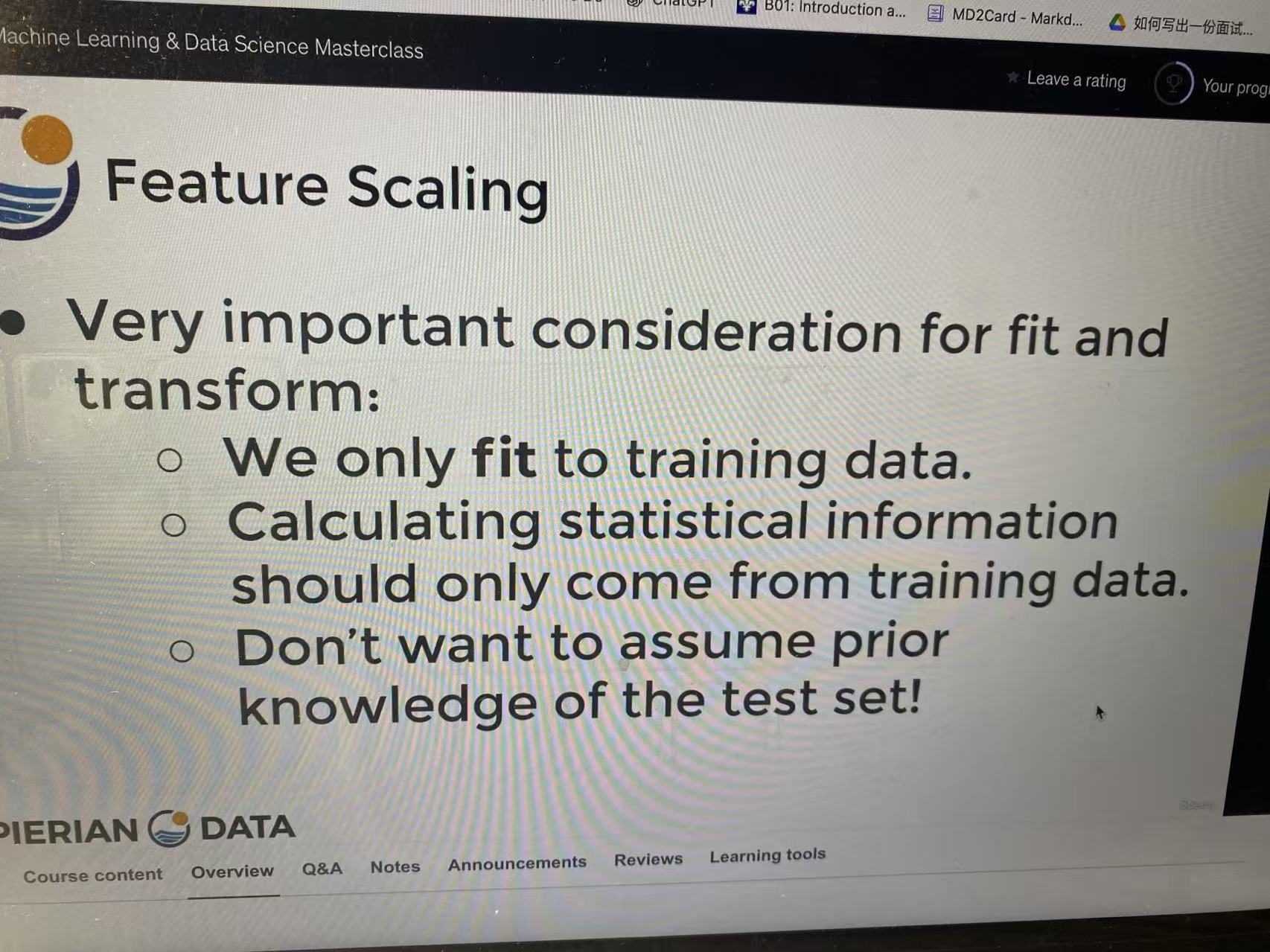
8️⃣ The correct workflow (very important)
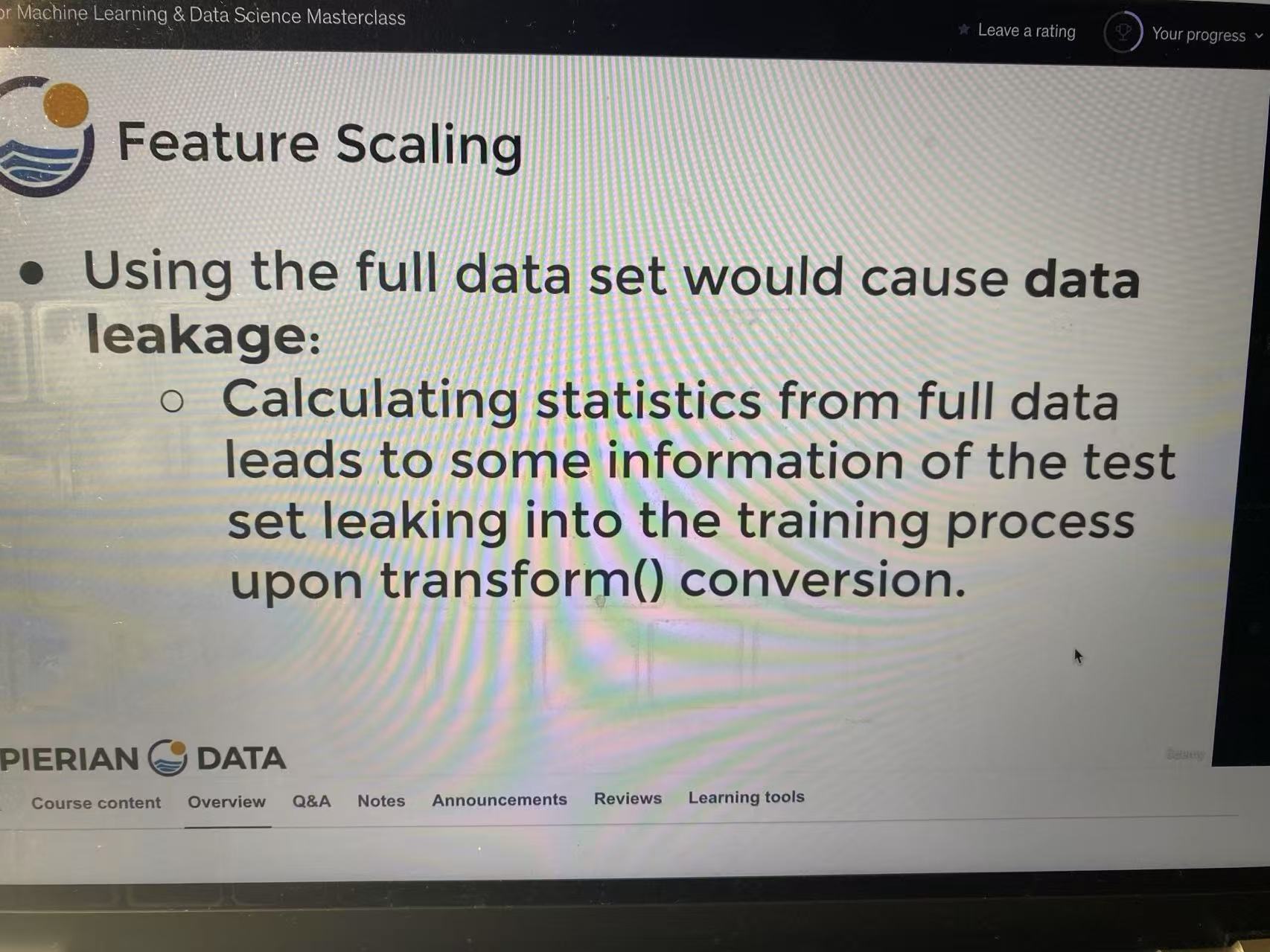
Never do this:
scale entire dataset
↓
train test split
This causes data leakage.
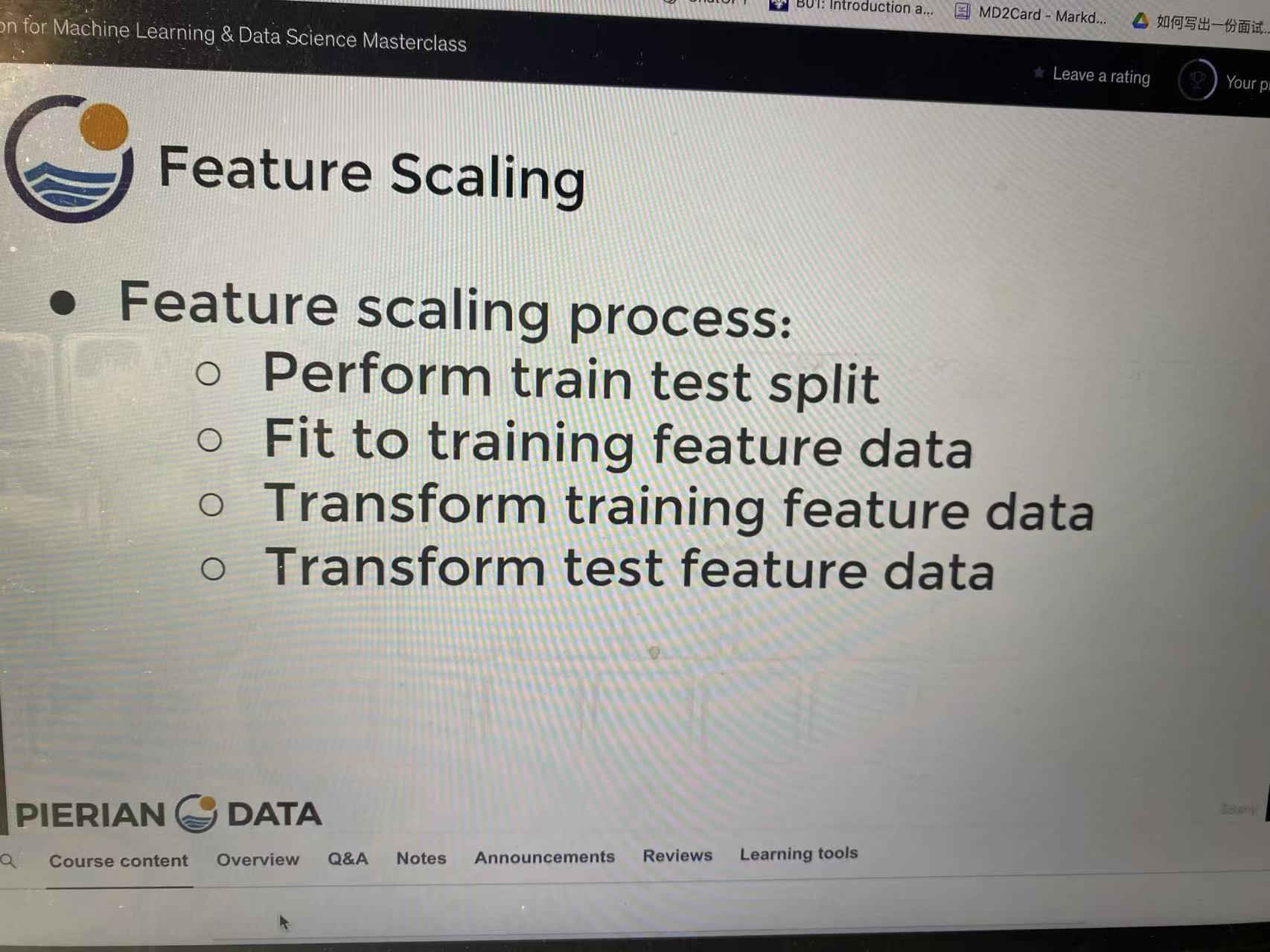
Correct workflow:
train test split
↓
fit scaler on train data
↓
transform train
↓
transform test using same scaler
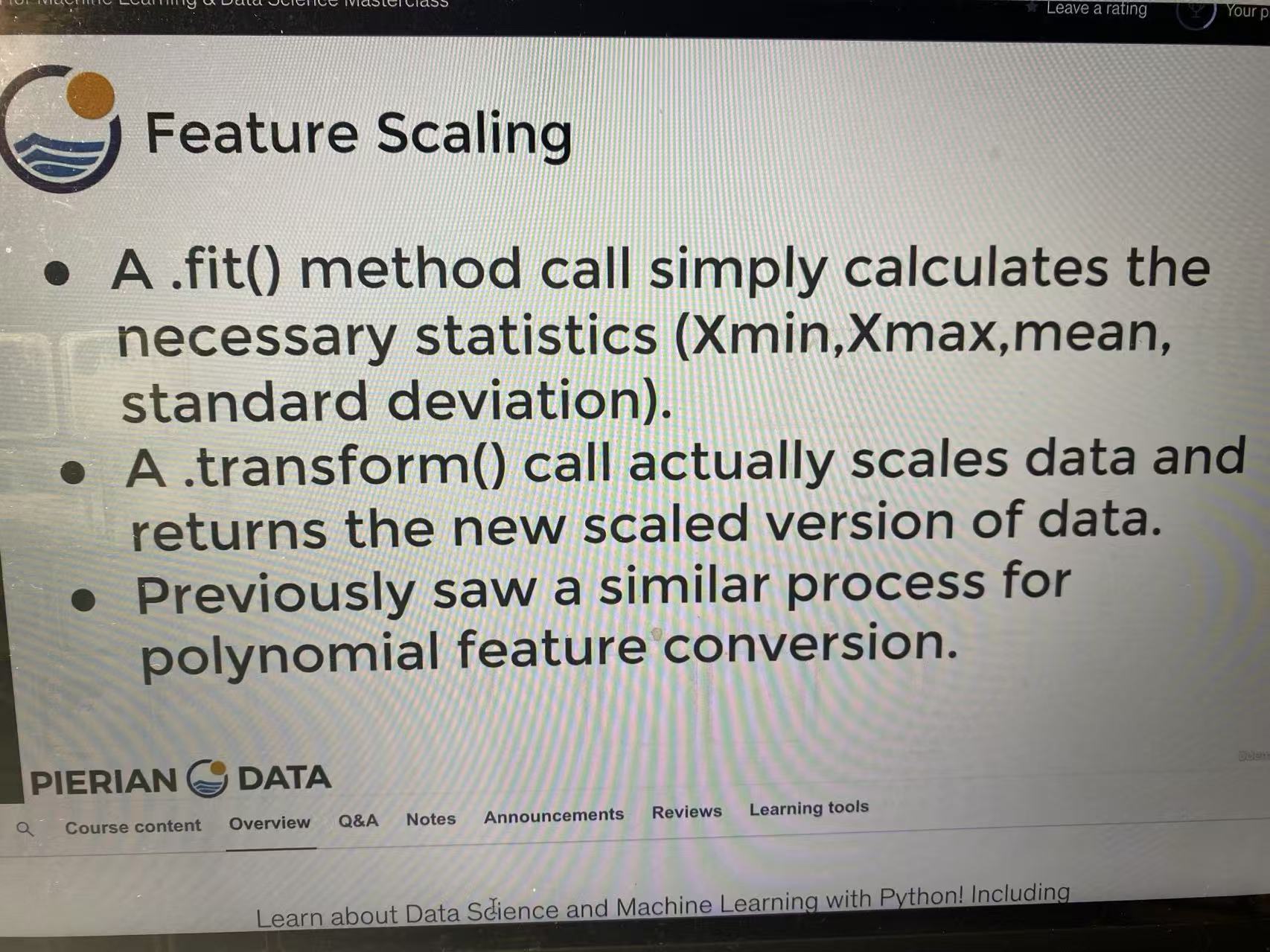
Example:
scaler = StandardScaler()

X_train_scaled = scaler.fit_transform(X_train)
X_test_scaled = scaler.transform(X_test)
Notice:
fit only on train
9️⃣ Real ML pipelines combine these steps
Typical ML pipeline:
Feature Engineering
↓
Feature Scaling
↓
Regularization / Model
Example in sklearn:
from sklearn.pipeline import Pipeline
from sklearn.preprocessing import StandardScaler
from sklearn.linear_model import Lasso

pipe = Pipeline([
    ("scaler", StandardScaler()),
    ("model", Lasso(alpha=0.1))
])

pipe.fit(X_train, y_train)
This prevents mistakes.
🔑 The big intuition
Feature scaling ensures:
model coefficients reflect importance, not measurement units
A small advanced insight (useful later)
Sometimes people scale before polynomial features.
Because otherwise:
x² explodes
Example:
TV budget = 200
TV² = 40000
Scaling first keeps polynomial features stable.